
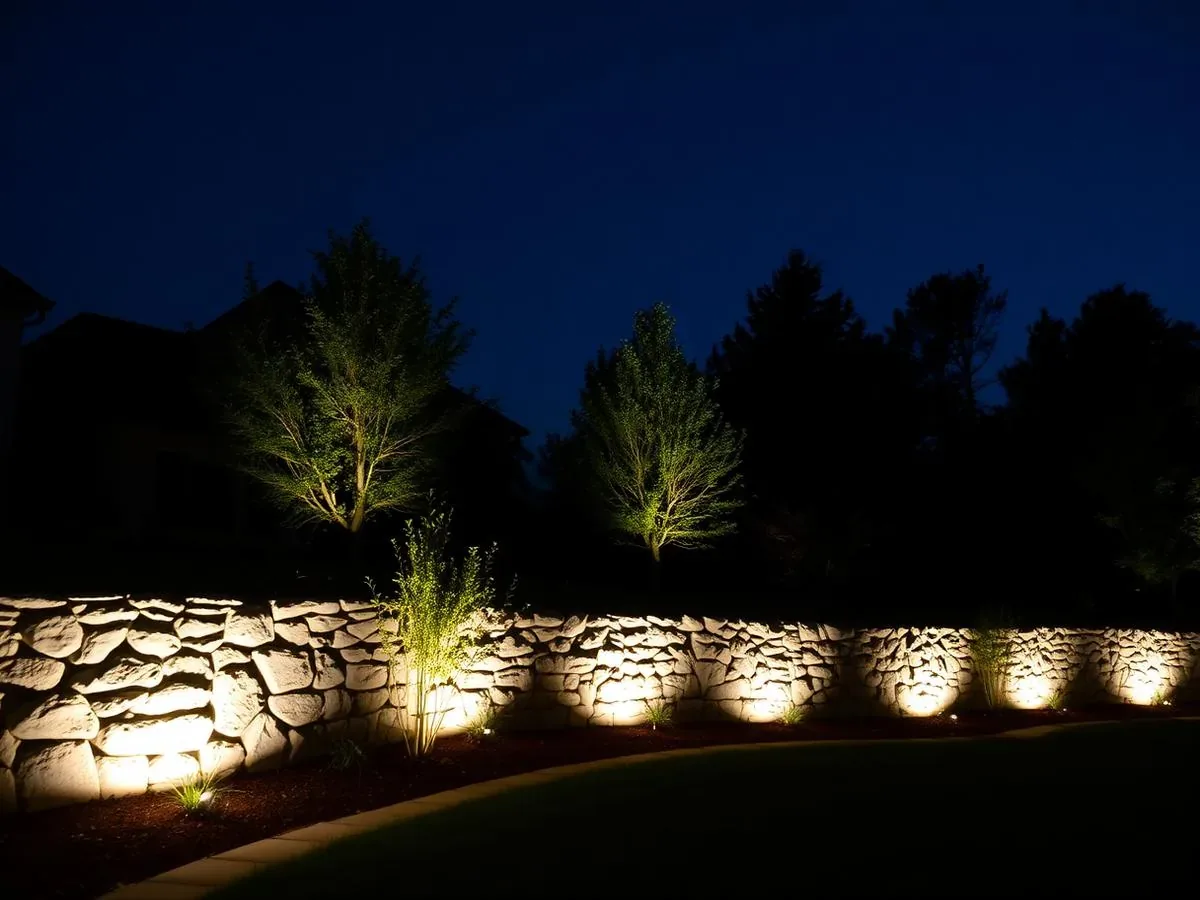
Good landscape lighting is almost invisible: you notice the stone wall, the old maple and the steps to the front door, not the fixtures. Bad lighting does the opposite. You notice the lights and everything else looks flat.
The difference rarely comes down to budget. It comes down to a handful of mistakes we see all over Fairfield County, and all of them are easy to avoid.
Mistake 1: The runway
A row of identical path lights spaced exactly six feet apart on both sides of the walk looks like an airport runway. It's the most common mistake, and it makes an expensive walkway look like a parking lot.
Instead: Stagger fixtures, vary spacing, and let pools of light overlap loosely. Light where the path turns, where there's a step or a change in grade, and at the destination. A walk doesn't need to be evenly bright to be safe, just readable.
Mistake 2: Cool white bulbs
LEDs labeled "daylight" or "cool white" (4000K and up) give stone, brick and plantings a harsh, bluish, clinical look. Bluestone looks gray and flat, and warm brick turns dull.
Instead: Use warm white, generally 2700K to 3000K. Warm light brings out the natural color in fieldstone, bluestone and brick, and it makes plantings and people look better too. Keep the color temperature consistent throughout the property so nothing looks patched together.
Mistake 3: Lights aimed at nothing
A spotlight pointed into an empty lawn, a fixture uplighting a plain stretch of siding, or a well light under a shrub that's since been removed. Light is only interesting when it lands on something.
Instead: Start with what deserves attention after dark: a specimen tree, a stone wall, a chimney, the front steps. Light those, and leave the rest in shadow. Darkness is part of the design. Contrast is what gives a yard depth.
Mistake 4: Glare
If you can see the bare bulb from the patio or the street, the lighting is working against you. Glare makes people squint and hides everything around it, and it can annoy neighbors.
Instead: Use shielded fixtures with hoods or glare guards, aim uplights away from seating and sightlines, and tuck fixtures behind plants or stones. You should see the effect, not the source. That also keeps light where it belongs instead of spilling into the neighbor's bedroom or the night sky.
Mistake 5: Ignoring the stonework
Masonry takes light beautifully when it's lit correctly, and most systems waste it.
Instead:
- Graze walls. Place a fixture close to the base of a stone wall or chimney and aim it straight up. The low angle catches every edge and shadow in the stone's face.
- Tuck lights under wall caps. Low-profile hardscape lights mounted under the cap of a seat wall or retaining wall wash the face in soft light with no visible fixture.
- Light every step. Step lights set into risers or the sides of stairs are both the safest and the most elegant way to light a grade change.
Mistake 6: Cheap fixtures and quick wiring
Plastic fixtures from a big-box kit crack, fade and fill with water within a few Connecticut winters, and salt air near the Sound speeds that up. Wires laid on the surface get cut by edgers and aerators.
Instead: Choose solid brass or copper fixtures, which weather to a natural patina and last for decades. Use a quality low-voltage transformer with a photocell or astronomic timer, and wire it so each fixture gets even voltage and the far ones aren't dimmer. Bury cable properly and plan for plants to grow.
Light the stone, not the yard
The goal isn't to make the yard bright. It's to let the best parts of it show up at night. If you've invested in a patio, wall or steps, the right lighting lets you enjoy them for hours more every evening. We're happy to show you what that looks like on your property, with a free visit from a Norwalk foreman.